For parents in Charlotte considering Providence Day for their child’s high school years, there is a great deal of published information to work through and very little guidance on what it means for one particular student. In this profile, we set out what the school offers in the Upper School—the course track, the college counseling, the admissions process, and the cost—and what kinds of students do best there.
Providence Day School is a strong choice by any of the usual measures, but for families hoping to maximize their child’s academic preparation and their chances at a selective university, we believe the things to look at are these: how wide the course list is and how the school limits it, how many seniors each college counselor works with, and where the senior class actually enrolls.
Dr. James Edge taught at Providence Day for five years before joining Menlo Coaching, so this is the school in our Charlotte series that we know from the inside. We assess it on the same criteria as the other schools, and we say below where it falls short for some students.
Providence Day is a private school in southeast Charlotte, not to be confused with the public Providence High School. For a side-by-side view of the four largest private schools in the city and Weddington High, see our guide to the best high schools in Charlotte, NC.
| Founded | 1970 |
| Grades | TK–12 |
| Total enrollment | 2,060 (2026–27) |
| Upper School (9–12) enrollment | 754 (2026–27) |
| Upper School tuition | $36,325 (2026–27; one rate for grades 6–12) |
| Families receiving financial aid | About 21% (2026–27) |
| Student-to-faculty ratio | 8:1, school-wide |
| Advanced courses | 30 AP courses, honors-weighted Advanced courses in every department, post-AP math and computer science |
| Religious affiliation | None (nonsectarian) |
| Campus | 45 acres on Sardis Road, southeast Charlotte |
| Athletics | NCISAA (Division I in football) |
| Niche overall grade | A+ (2027); #1 among Charlotte-area private high schools |
| Head of School | Dr. Glyn Cowlishaw (since 2011); Dr. Michael Magno becomes Head of School in June 2027 |
Figures are from Providence Day’s own 2026–27 publications and from Niche, which combines published data with parent and student reviews. Links are in the Providence Day Resources list at the end of this profile.
Dr. Glyn Cowlishaw, Head of School since 2011, retires at the end of 2026–27, and Dr. Michael Magno, currently Associate Head of School, takes over in June 2027. A student entering 9th grade in fall 2027 will spend all four years of Upper School under the new head.
Transitions of this kind rarely change a school’s academic program quickly, and Magno is being promoted from within, so we don’t expect families applying now to see a different school from the one described here.
The first thing most parents want to know about a high school’s academics is whether their child will run out of challenging courses, and at Providence Day the answer is almost certainly no. The school offers 30 Advanced Placement (AP) courses in 2026–27, from AP Physics C to AP Chinese. AP courses are college-level classes taught in high school, with a national exam each May, and they are the main way a US student shows a university that they have taken the hardest work available. Thirty is the longest AP list of the four large private schools in Charlotte, so a student with a defined interest, whether that is physics, a language, or economics, will find an advanced course in it.
There is no International Baccalaureate (IB) program, so a family that wants the IB Diploma, the more widely recognized credential outside the US, should look at alternatives like Charlotte Country Day.
There is also no dual enrollment, the arrangement at many public schools, Weddington among them, where students take courses at a local college for credit while still in high school. This matters less at Providence Day, because the school has built its own courses for students who finish the AP sequence early. AP Calculus BC is the last AP math course, and a student who completes it in 10th or 11th grade can go on to Calculus III, Differential Equations, and Linear Algebra, with Advanced Structures in Java beyond AP Computer Science. Every department also offers honors-weighted Advanced courses, meaning courses that carry extra GPA weight, as APs do, but follow the school’s own curriculum rather than the College Board’s.
The feature of the curriculum that surprises parents most is the limit on how many APs a student can take: the school recommends no more than 2 as a sophomore, 3 as a junior, and 4 as a senior. If your child is the kind of student who would take six, this can feel like a ceiling, but we believe it works in their favor.
Every AP student must sit the AP exam (tuition covers the fees), so the cap keeps students from signing up for more exams than they can prepare for. And because the policy is stated in the school profile that goes to universities with each application, a transcript with three APs in junior year is read as a transcript at the school’s maximum rather than as a light one.
The cap does not make the work light. The Course of Study sets expectations of 2.5 to 4 hours of homework a day, a figure to take seriously if your child also plans to play a varsity sport, and every senior completes a 30-hour internship as a required Senior Project. The results suggest the pacing works: in May 2026, 497 students took 1,282 AP exams, 93% of scores were 3 or higher, and 76% were 4s or 5s. A 3 is the usual threshold for college credit, and a score of 4 or 5 can materially improve a student’s application.
Because the number of APs is capped, a Providence Day student stands out by going deep in one area, and the school has built two optional second diplomas for exactly that:
The school advises students to choose one diploma or the other, and for a student applying to selective universities we would say the same: one defended capstone that the student can write about with real knowledge is worth more than two done thinly.
For a student whose interests are international or technical rather than entrepreneurial, two other programs are worth asking about on a visit. Providence Day is one of two Round Square schools in North Carolina, part of an international network built around global travel and exchange, and its IDEAS@PD program adds robotics, AI, and design work.
A school’s college counselor is a key figure in your child’s college application strategy, and parents should note how much attention each student can expect to receive on this front.
The college guidance office has five counselors, a director and four associate directors, who do nothing but college advising; the school counselors who handle academic and personal matters are a separate team. We recommend asking about this distinction at any school you visit, because a “counselor” at a public school usually does both jobs.
With 179 seniors in the Class of 2027, that works out to about 36 seniors per counselor by our calculation, or, in the school’s words, each counselor “works with one fifth of each Upper School class.” Thirty-six is a caseload at which a counselor can know each student well enough to write a recommendation letter with specifics in it. It is also higher than Charlotte Country Day’s 27, so a family for whom counselor time is the deciding factor should look there too. More than 150 college admissions representatives visit the campus each fall, which gives students a chance to be a name and a face to the person who may later read their file.
For the Class of 2026, the middle 50% of SAT scores ran from 1160 to 1420 and the middle 50% of ACT scores from 21 to 30, meaning half the class scored inside those ranges, a quarter above, and a quarter below. A child scoring above 1420 is in the top quarter of a strong class; one scoring around 1200 is in the middle of it, and the rest of the application has to carry more. The class also had 9 National Merit Finalists and 18 Commended Students, recognition awarded on the junior-year PSAT that admissions officers and scholarship programs treat as a marker of roughly the top 1% of test-takers nationally.
Providence Day does not rank its students, and for most families that is to their child’s advantage. Instead, the school profile sent with every application reports average GPA and test scores by quintile, so an admissions officer can see roughly which fifth of the class an applicant falls in without a single number that says “47th of 176.” In the Class of 2027, the top fifth averages a 1454 SAT and the bottom fifth a 1116. The comparison to classmates still happens; it just happens in bands of 35 students rather than one by one, which is kinder at the margins and no help at all to a student in the bottom fifth.
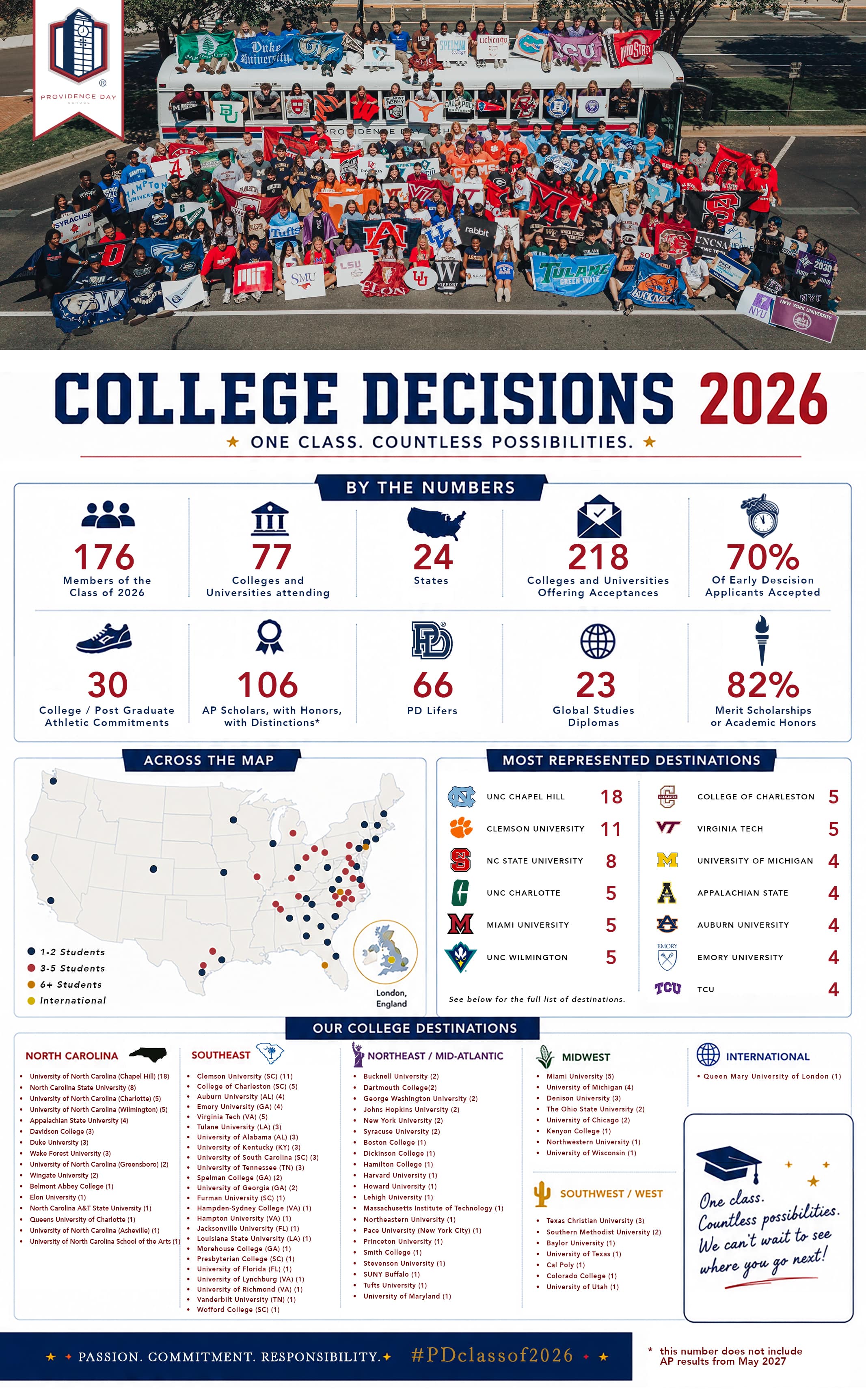
The 176 graduates of the Class of 2026 are enrolling at 77 colleges in 24 states, and 218 colleges offered admission to at least one of them. UNC-Chapel Hill was the top destination with 18 graduates, followed by Clemson (11) and NC State (8), so the typical Providence Day outcome is a strong public university in the Southeast rather than an Ivy. The most selective universities took a few each:
Eleven places at that group from a class of 176 is a good record for a Charlotte school, and it is also about 6% of the class, so a parent should read the list as proof that the path exists. For what those universities weigh, see our guide to how to get into the Ivy League.
Of the class’s Early Decision applicants, 70% were admitted. Early Decision is the binding option offered by many private universities: a student applies by early November and commits to attend if accepted. Because the commitment removes the university’s uncertainty about yield, ED acceptance rates are usually well above regular-round rates. A 70% figure says the counseling office is steering students toward ED choices they can get into, and it also means that ED is a decision to make in 10th or 11th grade, when the testing and course choices that support it are still open. That is also the stage to start building a balanced college list.
Finally, 13 graduates will compete in Division I, the top tier of US university athletics. With the class’s $21 million in scholarship offers, this is the number to look at if your child’s route to a university runs through a sport.
A matriculation list shows where a class of 176 went, and the Providence Day numbers show why that is a poor guide to where one student will go.
The range within the class is wide. The average SATs of the top and bottom fifths of the Class of 2027 are about 340 points apart, and a university reads the profile’s quintile data alongside the transcript, so where your child sits within that class carries weight in its own right. The school’s name and profile do more for a student in the top fifth than for one in the middle, and for a student in the middle the application itself has to do more of the work.
UNC-Chapel Hill is the single biggest destination. Eighteen graduates enrolled there in 2026, so the path is well worn, and it also means your child applies alongside a large group of classmates with similar transcripts and letters from the same counselors, competing for the same in-state places.
The second diplomas are where the school rewards depth, and we think they are the best thing on the course list for a student aiming high. A Global Studies or Entrepreneurial Studies capstone is a 12-page, defended piece of independent work completed before the application is due, which is exactly the kind of project a college essay can be built around. The 23 students who earned the Global Studies Diploma in 2026 are a small share of a class of 176, so it still sets a student apart within the school.
While the counselor to student ratio is relatively high, college counselors cannot give any one student the hours that a personal statement and a full set of supplemental essays take, and no counselor—ours included—can promise a result at the universities at the top of this list.
Planning ahead for college from Providence Day? James Edge taught at Providence Day and has worked with students from across Charlotte. Book a free consultation to talk through your child’s path.
Providence Day accepts applications for TK through 12th grade. For students entering grades 1–12 in fall 2027:
| Step | Date |
|---|---|
| All-School Open House (TK–12) | November 1, 2026, 2:00–4:00 p.m. |
| Application deadline, grades 1–12 | January 15, 2027 |
| Financial aid application deadline, new families | January 22, 2027 |
| All materials due, including ISEE scores | February 26, 2027 |
| Admission decisions | April 9, 2027, 4:00 p.m. |
Applicants for grades 6–12 must take the ISEE (Independent School Entrance Exam), and the school does not list the SSAT as an option. Non-native English speakers also take the TOEFL. Applicants submit a transcript and recommendations from their current English and math teachers, and complete an interview; a day visit is optional. The school does not publish an acceptance rate, and its site does not list the application fee.
For 9th-grade applicants, three things are worth doing early:
Tuition for 2026–27:
| Grade | Tuition |
|---|---|
| Transitional Kindergarten | $25,510 |
| Kindergarten | $28,010 |
| Grades 1–5 | $32,960 |
| Grades 6–12 | $36,325 |
Tuition covers more than at most schools in our series:
Extra costs include:
A $2,500 nonrefundable enrollment deposit is credited toward tuition, and families can pay in full or in 3, 10, or 12 installments.
Financial aid is need-based, and the school doesn’t publish its total aid budget. The aid application fee is $65, and the deadline for prospective families is January 22, 2027.
Athletics are a large part of life at Providence Day. The school fields 66 teams in 27 varsity sports, and more than 80% of students play on at least one team. In 2025–26 Providence Day won the NCISAA Wells Fargo Cup, the state association’s all-sports award, for the fourth straight year and the 13th time overall, and it won state titles in boys’ football, girls’ swimming, girls’ soccer, and girls’ lacrosse. A serious athlete gets a top NCISAA program here, and should ask how a varsity schedule fits with 2.5 to 4 hours of homework a night.
The arts program, based in the McMahon Fine Arts Center, includes band, chorus, orchestra, theater, and visual arts, and more than 100 Providence Day musicians have been selected for honors ensembles such as All-District and All-State. A student-run Honor Council of eight elected students and three faculty members upholds the school’s Honor Code.
Notable alumni include Olympic silver medalist Anna Cockrell (’16), Carolina Panthers offensive tackle Ikem “Ickey” Ekwonu (’19), and NBA forward Grant Williams (’16).
The other three large private schools in Charlotte differ from Providence Day mainly in size and track:
All four require the ISEE and set mid-January 2027 application deadlines.
Providence Day wins on course breadth and on athletics. It loses to Country Day on counselor caseload (about 27 seniors per counselor there against 36 here) and on the IB option, and it is the largest Upper School of the four, which suits a student who seeks things out; a student who needs to be noticed will generally do better in a smaller school. A family that wants the IB diploma, or a smaller school where a quieter child is known to every teacher, should look at Country Day first; a family that wants the widest course list and a big-school athletic and activities program should start here. See the full side-by-side comparison in our Guide to the Best Charlotte High Schools.
Is Providence Day hard to get into? Providence Day doesn’t publish an acceptance rate, so there is no number to compare.
Does Providence Day require the ISEE or SSAT? The ISEE. The school does not list the SSAT as an alternative, and non-native English speakers also take the TOEFL. ISEE scores are due with the rest of the file on February 26, 2027, for fall 2027 entry.
Is Providence Day a religious school? No. It is an independent, coeducational, nonsectarian college-preparatory day school with no religious affiliation. Families who want a faith-based education should look at Charlotte Christian, the one Christian school in our series.
Whether your child is choosing a high school or already at one, the course levels, number of APs, testing plan, and activities chosen in 9th and 10th grade shape the application three years later. If you’d like an honest assessment of where your child stands and what those choices should be, book a free consultation with Menlo Coaching’s Charlotte team.

James Edge, PhD
Director & Sr. College Admissions Consultant
Education: BA
Based in Charlotte, NC, James has helped students win admission to Yale, Stanford, Harvard, Princeton, Duke, and more. A former Providence Day teacher, he combines deep local knowledge, candid strategy, expert writing coaching, and a talent for helping students translate years of hard work into standout applications.
Speak with our strategic advisors to evaluate profile fit, identify best-fit target schools (Ivy League or otherwise), and define a clear application roadmap.