
For professionals looking to take the next step in their business education without dropping out of the workforce for two years, an Executive MBA (EMBA) is often a perfect fit.
For this article, we asked Manoj Thomas, the Associate Dean of NYC Initiatives for Cornell SC Johnson College of Business and Senior Director of the Johnson School’s EMBA and NYC programs, about the school’s unique hybrid EMBA Americas program, the growth of remote learning, and how Cornell’s “any person, any study” ethos informs its extensive catalog of specialized programs.
Like many industries, higher education had to shift gears to adapt to the COVID-19 pandemic in 2020, and one of the biggest results was the widespread adoption of distance learning.
Just like the growth in working from home in other industries, the change stuck around to a great extent after the original impetus faded, as many students and institutions discovered the advantages of the distance learning format.
“During COVID, almost all the universities in the world were forced—despite their hesitation—to offer online classes. In the process, instructors and students realized this format can work very well for a certain population. And COVID receded, but the demand for distance education kept growing.
“Cornell has been fortunate in a way to be at the forefront of this transformation.”
In collaboration with Queen’s University, Kingston, Cornell launched its two-year EMBA Americas program in 2005 as a completely novel take on the format. The program allowed participants from across the US, Canada, and Latin America to participate remotely via a series of networked “boardrooms.”
“This was years before the launch of Zoom. We actually used a hardwired connection. We set up what we called ‘boardrooms,’ classrooms with large screens for video communication, distributed all across the continent: Ithaca, NYC, the Bay Area, Houston, Dallas, Mexico City, Monterrey, Seattle, LA, DC, Boston, Toronto, Kingston …”
From a specially designed studio, “almost like a TV studio,” the instructor would teach students in all these different boardrooms at once: “We learned how to create an immersive classroom experience, facilitating interaction between the geographically dispersed members of one big virtual class.”
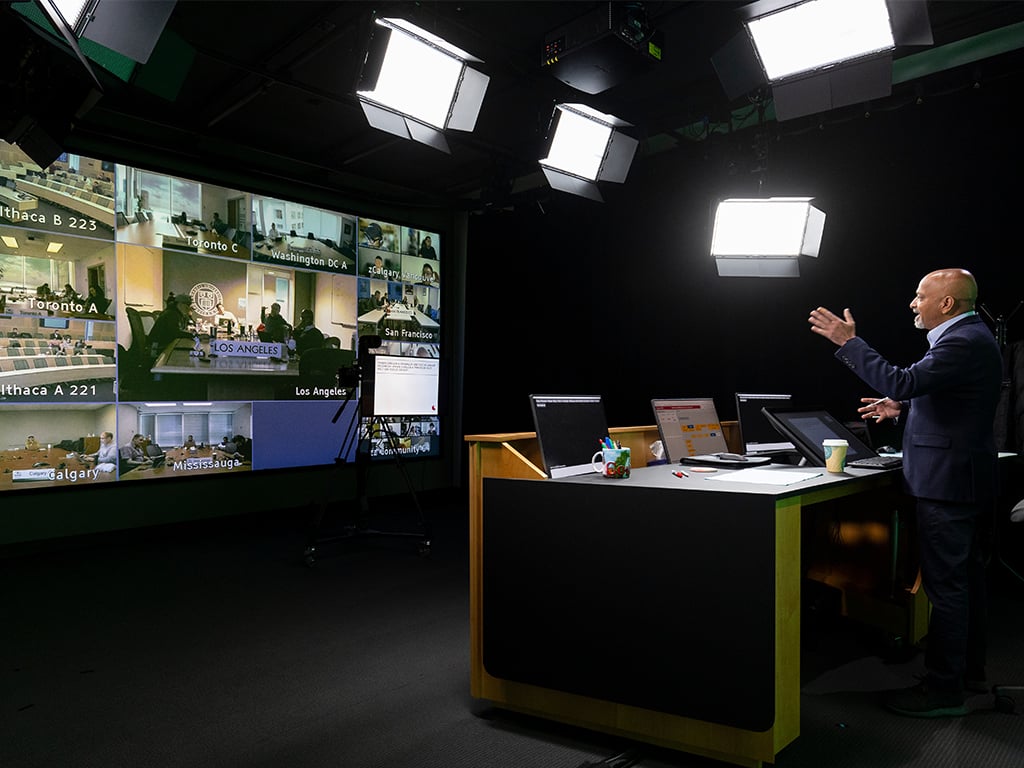
The members of each boardroom form a team within the larger cohort, working together in person but also interacting virtually with other teams. It was the first program in the country to use this kind of hybrid format.
While retaining the boardroom concept, the program has since evolved to push that flexibility further still:
“Post-COVID, many students expressed interest in attending the program from home, via Zoom. Now that we offer this option, we’re seeing more and more students participating in this way—over half the class in recent years.”
These remote participants are still networked into virtual teams; team-based work is an essential part of Cornell’s MBA programs across the board.
The whole cohort comes together in person four times during the program for a series of intensive weeklong residencies in Ithaca, Toronto, NYC, and Kingston, strengthening bonds and further differentiating the program from purely online MBAs.
| Useful Links | Program Homepage Application Requirements Class Profile Boardroom Locations Residency Details |
| Class Size* | 124 |
| Average Work Experience (Years)* | 14 |
| International Students* | 47% |
| Industries* | Finance: 21% Govt./Public Sector/Defense: 11% Tech/Engineering: 10% Healthcare: 10% Consumer Products/Retail: 8% |
Ezra Cornell’s stated ambition to “found an institution where any person can find instruction in any study” became the university’s motto. And the “any person, any study” ethos informs the exceptionally customized, bespoke range of programs offered at all the university’s constituent schools, Johnson included.
Case in point: The EMBA Americas program is one of three EMBA programs offered by the school, alongside the EMBA Metro NY program, taught in person on the Cornell Tech campus in NYC, and the EMBA/MS in Healthcare Leadership, taught in conjunction with Weill Cornell Medicine (also in NYC).
Beyond its hybrid format, the Americas program is also distinguished from these alternatives by its openness to applicants with less experience than the average EMBA candidate. As Manoj stresses, “anyone with five years or more of professional experience, who wants to pursue an MBA in the weekends without leaving their current job, is welcome to apply to this program.”
More generally, by dividing its program offerings into a range of options targeting students with different goals and backgrounds, Cornell is able to maintain smaller, more specialized cohorts than its Ivy League peers.
“I think we’re different from the other Ivies in the sense that we have three different EMBA programs customized for different working professionals: EMBA Americas for working professionals interested in an online MBA; EMBA NYC for working professionals interested in an in-person MBA in the city; and EMBA/MS for doctors, nurses, and medical professionals interested in healthcare leadership.”
The same spirit is visible in all Johnson’s offerings. The school’s MS in Business Analytics (MSBA) is similarly available in three formats: a 16-month online program for working professionals, a 10-month NYC program for full-time students, and a flexible part-time NYC program for people working in the city.

Mike Mascarenhas
Sr. MBA Admissions Consultant
Education: BS, MBA
With over 2,000 hours of experience coaching MBA prospectives and students, Mike knows everything about how to get into MBA programs—and how to land the best jobs coming out of them. Mike built the recruiting process at IESE Business School and subsequently handled MBA recruiting at BCG. He’s a passionate, energetic coach with a deep understanding of the consulting industry and substantial experience with nontraditional candidates.