
This article lays out the “dirty secrets” of admissions consulting, and gives some tips about how and why you should take a holistic approach during your selection process of hiring an MBA admissions consultant.
When you began your search to hire an MBA admissions consultant, the first dilemma you probably encountered was that every admissions consulting firm across the world seemed to have identical five-star ratings. Will the real Slim Shady please stand up? We’re gonna have a problem here …
|
 (5.0) (5.0)
|
|||||
|
(5.0)
|
|||||
|
(4.9)
|
|||||
|
(5.0)
|
|||||
|
(5.0)
|
|||||
|
(4.9)
|
|||||
|
(5.0)
|
|||||
|
(4.9)
|
|||||
|
(5.0)
|
|||||
|
(5.0)
|
|||||
|
(5.0)
|
|||||
|
(5.0)
|
|||||
|
(5.0)
|
|||||
|
(5.0)
|
|||||
|
(5.0)
|
|||||
|
(5.0)
|
|||||
|
(5.0)
|
|||||
|
(4.7)
|
Reviews like the GMAT Club ones shown above do have their uses, in the sense that reading through them carefully can sometimes produce insights. But did you realize that:
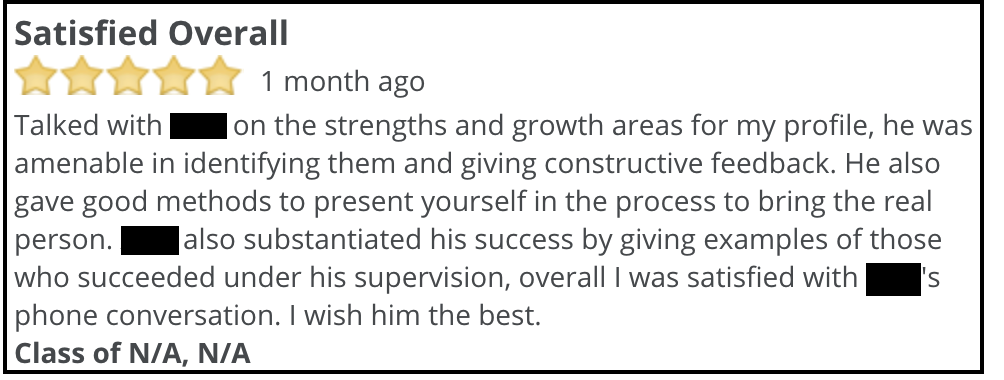
For the full story on reviews, see our article “MBA Admissions Consulting Reviews: Are They Real?” TL;DR: you can’t rely exclusively on reviews.
And these reviews, with all their issues, are the basis for the MBA admissions consultant rankings you’ll see online.
This means if you want to find an admissions consultant who will give you a real advantage in the MBA admissions process, you have to dig deeper and learn about how MBA admissions consulting firms differ.
To provide more transparency, we offer video case studies and reviews with real former clients at Menlo Coaching reviews.
Pretty much across the board, admissions consulting firms talk a big game about hiring former admissions officers (AdComs) from top MBA programs, or others with behind-the-scenes admissions experience.
Why does this matter? It’s not because these consultants are going to call up their connections at the school and get you admitted on the spot. Thankfully, that’s not how it works.
If they bother to explain the usefulness of AdCom experience at all, firms typically frame it as a source of valuable “institutional insights” or “insider secrets” about the admissions process, or a firsthand perspective on “what schools are looking for.”
This is not entirely unreasonable. It’s obvious that some level of personal insight into how admissions committees work behind the scenes is a valuable asset for a consulting firm. Having this kind of experience on the team sends a strong credibility signal to clients, and it helps ensure less obvious “red flags” in your profile are not overlooked.
Menlo Coaching’s own Luke Anthony Peña brings with him years of experience as Director of Admissions at Stanford GSB and Dartmouth Tuck, followed by several years leading Stanford’s exceptionally selective Knight-Hennessy Scholars program.
This kind of senior experience provides an exceptional foundation for Luke’s work now, but he emphasizes that it’s not a magic bullet:
“I’ve made the final decision on well over 10,000 MBA applications. People ask me how the evaluation process goes, and I’ve always believed in being transparent about it.
“But the simple truth is that the application review process is not some arcane secret; there’s no key I can hand you or loophole I can tell you how to exploit. No one should sign up for admissions consulting with those expectations.
“Rather, I tell potential clients: You should sign up with me if you want a coach who is committed, realistic, conscientious, and encouraging, who is thoroughly invested in your candidacy and willing to pull out all the stops to help you succeed.”

But frankly, firms tend to overstate the importance of AdCom backgrounds.
The experience of reviewing applications is just not the same as coaching someone on how best to present themselves in their application. Distinguishing between good and bad applications takes critical judgment, but fundamentally, an AdCom’s role is to reject weak candidates and admit strong ones—not turn the former into the latter.
Then, it’s worth emphasizing that there are no insider “cheat codes” that will magically get you admitted. At the end of the day, schools don’t hide what they’re looking for. They describe it in plain text on their websites: students who can handle the coursework, get a great job, and help their classmates along the way.
That’s not to say there are no nuances to how schools build their classes, or that expertise has no value. Rather, it’s important to understand that the work of admissions consulting is about effective coaching and storytelling, not telling you the secret password that gets you a Wharton admit.

Firms will also talk about consultants’ past AdCom experience as if it kept them particularly in the loop about what schools’ admissions decisions look like now.
But of course, priorities and processes change over time, and in order to know what’s happening behind the scenes now, a consultant would have to be a current AdCom—something that would represent a pretty big conflict of interest for the school!
And applying the same logic to where the consultant’s AdCom experience comes from, it should be clear that experience of the admissions process at one school doesn’t necessarily generalize to other programs: Stanford is not Columbia is not Stern is not Kelley is not INSEAD …
In other words, don’t be dazzled by consultants’ prestigious AdCom backgrounds. And as we discuss next, that’s not the only credential firms play up to win customers.
Besides AdCom experience, the other constant feature of consulting firms’ marketing is endless talk about their consultants’ own MBAs from top programs. (Along with attempts to conflate the two: “Our consultants are all former admissions officers and/or graduates from M7 MBA programs …”)
On the face of it, direct experience applying (successfully) to top programs seems like a strong qualification for the job. You want a consultant with a firsthand understanding of the process, after all.
The argument for a consultant who attended your target program seems especially plausible. Sites like Leland cater to this thinking, offering the option to filter consultants by alma mater. I want to get into HBS. This person clearly knows how to do so … right?
But the key assumption underpinning both arguments (for hiring an MBA graduate, and for hiring a graduate of your target program) is shaky. Namely, that successfully applying to a program for yourself means you’ll be good at helping other people apply.
Think of it this way: If you’re reading this, you presumably went to college. Are you an expert college admissions counselor?
You probably have a driver’s license. Are you a qualified driving instructor?
You speak English. Are you an English teacher?
The fact is that people are admitted to prestigious MBA programs for a variety of reasons:
These or similar factors may have led to admissions success for your Harvard-educated consultant—without implying any special talent for constructing strong applications.
Besides this key flaw in the logic, you should also bear in mind that a consultant with an MBA knows something about the admissions process … at the school they applied to, at the time they applied (5 years ago? 10?), from the perspective of an individual applicant with their specific goals and background. This knowledge is, again, not necessarily generalizable.
People who get MBAs do not do so in order to pursue a career in admissions consulting. The MBA is designed to open up much more lucrative opportunities.
MBA graduates who work in admissions consulting are usually doing it as a flexible side hustle they can balance with other commitments, such as bootstrapping a startup or working a full-time corporate job. Your applications are not the top priority for someone in this position.
Be aware, too, that when firms talk up their “full-time” consultants, they are often using the term very loosely. For example, we’ve met a “full-time MBA admissions consultant” who also held a director-level role at a media agency, another who was running a family office that invested in real estate, and another who was a manager at a well-known consulting firm.
At Menlo Coaching, our staff work full-time and are committed to admissions consulting as a career, not a side hustle. We hire consultants based on proven coaching and storytelling ability, not whether they hold an MBA.
It’s completely natural, when shopping for a consultant, to get sick of vague marketing spiel and long for some hard stats you can use to objectively compare firms—namely, success rates.
You’ll find some firms that cater to this instinct, listing a (high) success rate on their homepage. You should be skeptical of this number, for three reasons.
The most obvious point is that you simply have no way to verify the success rates claimed by firms. These claims are not meaningfully scrutinized by any advertising standards authority, and you certainly have no way of investigating them as an individual consumer. (Even when a firm claims their stats are “audited” by a third party, you still have to take their word for it.)
We’ve encountered some pretty silly numbers in admissions consulting firms’ marketing. One firm claimed its clients had a 74% acceptance rate at Stanford GSB. If you know anything about the top MBA programs, you’re probably aware that Stanford consistently maintains the lowest acceptance rate of all, accepting something like 7% of applicants.
In other words, the firm was claiming to give its clients over 10 times better odds than the average Stanford applicant. If you believe that claim … well, ask us for their contact details and sign up!
Firms that list an overall success rate are typically not very forthcoming about exactly what the number represents.
This ambiguity transfers onto you, the shopper: You feel like asking about success rates is a smart question … but do you know what you’re really asking? Is success counted per application? Per client? If per client, what exactly counts as success?
Let’s take an artificially short list of clients as an example:
What is the success rate of the consulting firm with these results?
Depending on how the stat is calculated, the firm could quite plausibly list a 100% success rate based on these results. But it’s fair to say that these are not the results you imagine when you see “100% success rate.”
These ambiguities not only make success rates pretty useless to you, they provide extensive cover for firms looking to fudge the numbers.
In the absence of a clearer definition, the generous interpretation of “success rate” is the proportion of a firm’s comprehensive clients who were accepted at one of their target schools, even if they were rejected by some others.
This excludes more limited engagements where the client received, say, only an hour or two of coaching that may have had little impact on the outcome; and it excludes cases where the only “success” was admittance to a “safety school” the client had little interest in attending.
There are two clear ways to manipulate even this stat:
In other words, firms want you to interpret a high success rate as a sign that their services are effective, but in reality it could just mean that they take on well-qualified candidates and push them to apply to middling programs.
We’re not trying to make any claims about whether specific firms are manipulating their numbers in this way—nor to suggest that anyone should be taking on clients with infeasible goals. Within reason, it’s just good business for an admissions consulting firm to take on clients with decent profiles and realistic goals, turning down those who would just be wasting their money.
But the point is that excessive focus on these stats creates perverse incentives that work against clients’ interests. Seriously optimizing for success rate entails engaging clients for applications with which they simply don’t need help, and then taking credit for their basically inevitable success.
There are a few other “red flags” to watch out for when shopping around for admissions consulting. These are points you can pick up on during your initial conversations with the firm’s salespeople or coaches—signals that should give you pause about whether the firm’s approach is really focused on client success.
One unfortunately common sales tactic in the admissions consulting industry is trying to scare prospective clients and break down their confidence to convince them they need the firm’s help—essentially, negging.
We’ve worked with clients who told us that what quickly turned them off some other options in their search for an admissions consultant was the disparaging, superior tone in which they communicated. Leads are treated dismissively, told they have no chance of admittance to their target schools without the consultant’s help, and made to feel insecure and naive.
This attitude is dishonest and promises a toxic coaching relationship. More responsible firms and coaches will tell you if your goals or assumptions are misguided, but they will do so in a respectful, constructive way—not tear you down and exploit your anxieties with exaggerated pessimism. Crucially, if they truly think your goals are crazy, they’ll simply decline to work with you.
If a firm is telling you that you’d be lucky to win admission even to a lower-ranked business school, and you need all the help you can get, while simultaneously pushing you to sign up … they’re setting you up to be grateful for a mediocre result later.
Conversely, you may well encounter firms that attempt to dazzle you with unrealistic optimism about your odds—“For sure, we can absolutely get you into Stanford”—or vapid feel-good talk—“We believe everyone can achieve their MBA goals with our guidance!”
The fact is, at top-ranked schools, there are simply no guarantees. It can be a relief to encounter some positivity in a process where the odds seem stacked against you. But when that positivity is not grounded in a realistic assessment of your profile, it’s just a sales tactic.
That’s why it’s generally accompanied by pressure to sign up immediately, without the due diligence.
Trustworthy firms always prescreen clients to check that their goals are reasonable and that there is a fit with the coach’s approach. If a firm wants to get you signed up without having:
… be very wary! Firms using these tactics are simply rushing to sign up a large number of clients, maximizing income without worrying about whether the engagement will be a success.
A simple litmus test: If you see a “Buy It Now” button on the firm’s site, or something else to suggest you can sign up and pay without first going through proper screening, it’s a very bad sign.
One way that firms with unworkably high client-to-coach ratios will attempt to bridge the gap is by offloading some of the coach’s work—onto subordinates behind the scenes, and onto the client in the form of worksheets and templates.
Coaches who sign up more clients than they can realistically serve typically cope by delegating parts of the process to subordinate staff. This is often done covertly.
A pattern we’ve heard about from former clients of other firms is an initial in-depth call with the coach, followed by a switch to email communication for the remainder of the process. Even if the coach’s name is still on the emails, it’s far from clear who’s actually doing the work, and face-to-face interaction becomes rare.
In some cases it’s paperwork, not people, between you and the coach. Each of the italicized phrases was copy-pasted from a major firm’s intake document:
Example 1: Please review the Essay Writing and Personal Statements chapters in the ______ MBA Admissions Guide
Just what you needed! Reading “The 90-Day Step-by-Step Plan to Business School Acceptance (Now with Extra Footnotes)” before you start work.
Example 2: Please do not send your brainstorming document to your consultant without including the essay prompts AND your initial ideas for potential topics for each essay
Tracking down essay prompts and recommender questions should be built into the service, and brainstorming should really be done with a consultant, one on one. Writing a great MBA application is a creative process; it shouldn’t (and can’t effectively) be reduced to a generic template, formula, or worksheet.
Of course, firms know that clients want a personalized service, so they’ll usually try to paint their process in that light, whatever the reality. This makes it tricky to pick up on this problem before signing up, but there are some questions you can ask to probe how personalized the firm’s approach really is:

Now that you know a little bit more about the MBA admissions consulting landscape, we want to tell you how we use our knowledge to provide you with the best service.
We’ll keep it brief.
Some firms have formal or informal policies in place that limit the number of phone calls, iterations on an essay, mock interviews, or similar things that you are entitled to, and you may or may not hear about these policies before you become a client.
We know from experience that spending enough time with each client increases the odds of success, and successful clients drive referrals.
Our packages include unlimited coaching with a full-time, experienced MBA admissions consultant with:
We’ll be alongside you from the moment you decide to do an MBA to the moment you’ve enrolled at your target program, including any scholarship negotiations.
Alongside unlimited coaching, you will also get:
If you’re interested in an honest assessment of your chances and you’d like to learn more about our MBA admissions consulting service, contact us today.

David White
Founding Partner
Education: BS
David studied at UC Berkeley and worked as a tech industry professional, including stints at Yahoo! and Efficient Frontier, before co-founding Menlo Coaching. He has been listed among Poets & Quants’ Best Admissions Consultants and featured for his expertise—and tell-it-like-it-is attitude—in publications like The Wall Street Journal and MBA.com.
Our free, comprehensive checklist covers everything you need to shop for an MBA admissions consultant.